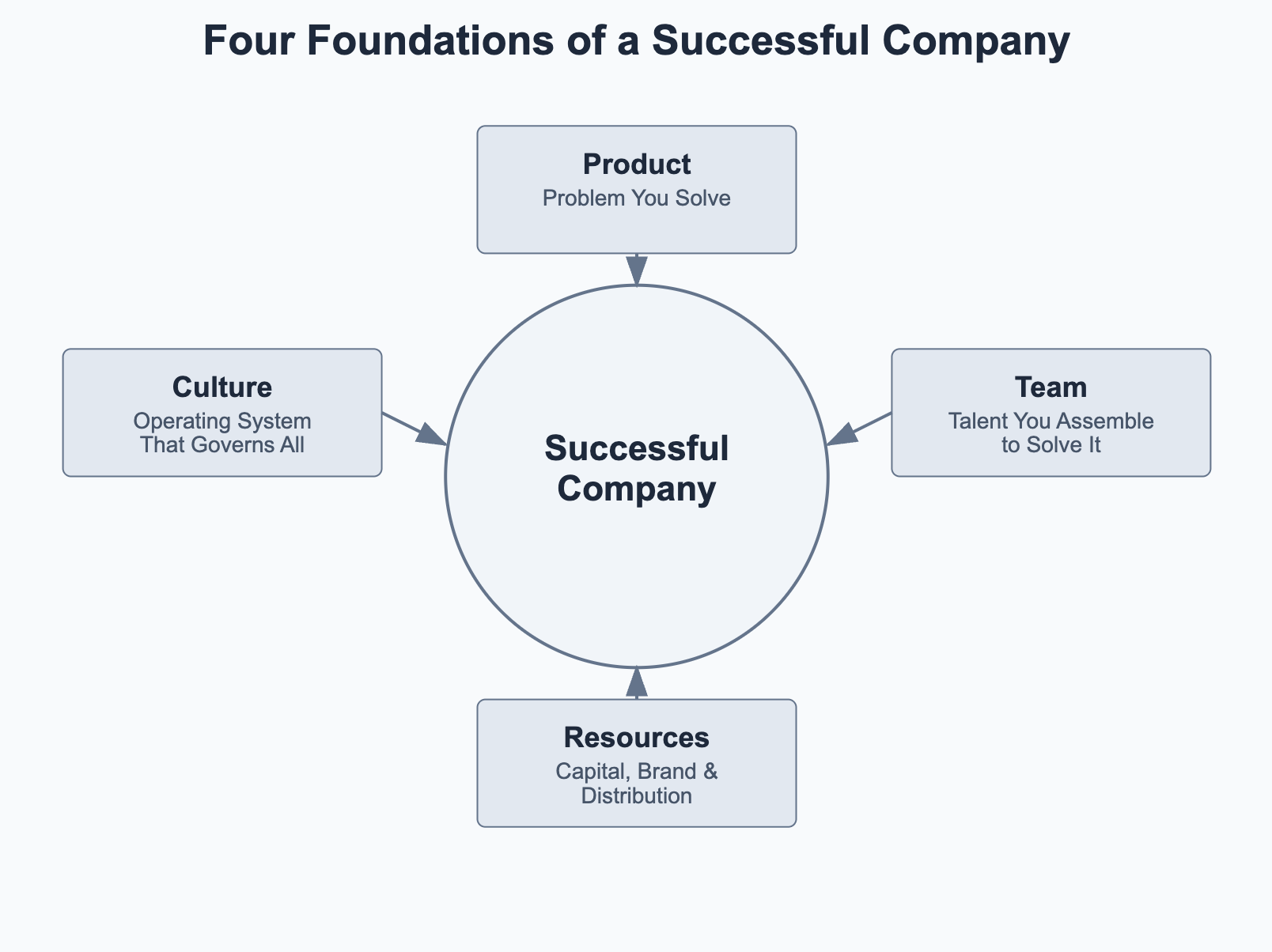
A successful company is rarely built on a single strength. At its core, it rests on four foundations: product, team, resources, and culture.
- Product is the problem you solve.
- Team is the talent you assemble to solve it.
- Resources are the fuel—capital, brand, and distribution.
- Culture is the operating system that governs how everything runs.
Recently, I’ve gained a deeper appreciation for the role of management systems and culture.
I’ve come to see its evolution in three distinct stages, best measured by how the team experiences its leader.
Stage 1: The System — The CEO is Feared (or at least, closely watched)
In the beginning, the founder’s will is everything. You have a unique insight, and you drive progress through sheer force and tight control. The product is the only thing that matters.
But once you find product-market fit, the company has to grow beyond you. This is the awkward stage of scaling. You introduce formal management: departments, levels, OKRs, KPIs. It’s a heavy, clunky scaffolding, but it’s necessary to stop things from breaking.
In this phase, the CEO’s job is to be the system’s enforcer. You’re in the trenches, driving execution, and making unpopular decisions to instill discipline. The team might not love you for it, but they follow the rules because you’re watching. Leadership is direct, visible, and top-down. It works, but it doesn’t scale.
Stage 2: The Habits — The CEO is Respected
The management system doesn’t change much between Stage 1 and 2. What changes is the team’s behavior. The rules on paper start to become rituals in practice.
Culture emerges in the small, consistent actions that need no top-down command:
- Every meeting ends with clear action items and owners.
- Product mocks are debated based on customer delight, not just short-term metrics.
But here’s the trap: many assume culture comes simply from hiring for perfect alignment. In reality, very few candidates are born fully compatible with company values. More often, people bring different strengths and weaknesses:
- Someone executes with precision but lack first-principles thinking.
- Someone thinks deeply but dislike tedious execution.
- Human nature is hard to change. No amount of lectures, rules, or KPIs can rewrite someone’s core traits.
Your job isn’t to change their nature. It’s to shape the environment. You create a feedback loop—rewarding aligned behaviors, course-correcting misaligned ones—until the desired habits become muscle memory. The team follows the norms not because the CEO is watching, but because the team is watching.
Stage 3: The Values — The CEO is Invisible
The final stage is the hardest to reach. Here, the CEO’s presence is barely felt in day-to-day operations. The company runs on a deeply embedded set of values that function like an immune system, automatically rejecting behaviors that don’t fit and nurturing those that do.
It takes years to reach this stage.
A vivid example comes from Anker, the global leader in charging accessories (even Trump has used their power banks). At one point, Anker had over 80 versions of power banks list on their store. Quantity diluted efficiency, and despite repeated warnings, the pattern persisted.


The CEO,Steven Yang wanted an Apple-like focus: fewer, better products. But commands, OKRs, and KPIs all failed. For an individual product manager, shipping more SKUs was a rational way to de-risk their career and look busy.
To flip the logic, the CEO introduced a penalty mechanism:
- Each category had a products cap. If a team exceeded it, their bonuses were cut. Too many SKUs, and the bonus dropped to zero.
The initial friction was immense. Many PMs quit.
But the ones who stayed believed in the philosophy of “less is more.” The culture shifted almost overnight. The wasteful 80-product problem vanished because the system was now wired to reward focus. The CEO didn’t need to approve every product decision anymore; the culture did it for him.
It is a process from stage 1 to stage 2, and he claimed that Anker yet enter stage 3.
When we look across these three stages, a pattern emerges:
- Stage 1 depends on systems and management.
- Stage 2 depends on habits and shared practices.
- Stage 3 depends on values embedded so deeply that they function as an invisible operating system.
This is the paradox of building: the more invisible the CEO becomes, the more powerful the company becomes. The less you rely on top-down control, the more the organization becomes self-sustaining.
Culture isn’t the soft stuff you deal with after you’ve figured out product and growth. It’s the hardest system you will ever build—and the only one that truly scales. In an era where AI can automate workflows, a dense culture is what automates decisions. One offers efficiency; the other builds an enduring company.