
The Great Compression
Everyone is worried about AI replacing the bottom 10% of the workforce. They are looking in the wrong direction.
Jason Lemkin (SaaStr) attended Lenny’s podcast, and he laid out a frightening new reality:
A team of 1.2 humans and 20 AI agents can now outperform a traditional sales team of 10 people.
For the last decade, the formula for scaling was simple: If you want $10M in ARR, you hire an army of SDRs to smash phones and send emails. It was a brute-force game.
This type of game is over.
The “Entry-Level SDR” is dead. Not dying—dead. The idea of paying a human to copy-paste emails or qualify leads is meaningless.
But the disruption goes deeper than just efficiency. It’s changing the nature of the sale itself.
Customers don’t want “relationships” with a mediocre sales rep who takes 24 hours to reply. They want answers. Immediate, technical, accurate answers. They want “Service-First Sales”
This isn’t just a “Sales” evolution. It is a compression event. The walls between Sales, Product, and Engineering are collapsing. And from the rubble, a new species is emerging.
The End of “Let Me Check with Product”
In the old world, the B2B sales cycle was like:
- Client asks for a specific customization.
- Sales says “I’ll check with Product.”
- Product puts it on a roadmap for Q3.
- Client walks away.
We accepted this inefficiency because building software was expensive. You couldn’t just “whip up” a custom dashboard for one prospect.
Today, if a client says, “I need this report to integrate with my weird legacy ERP,” you don’t call a PM. You don’t call an Engineer. You open your laptop, summon an agent, and you build it. Live. On the call.
It is the power brought by Lovable, V0, and Claude Code….
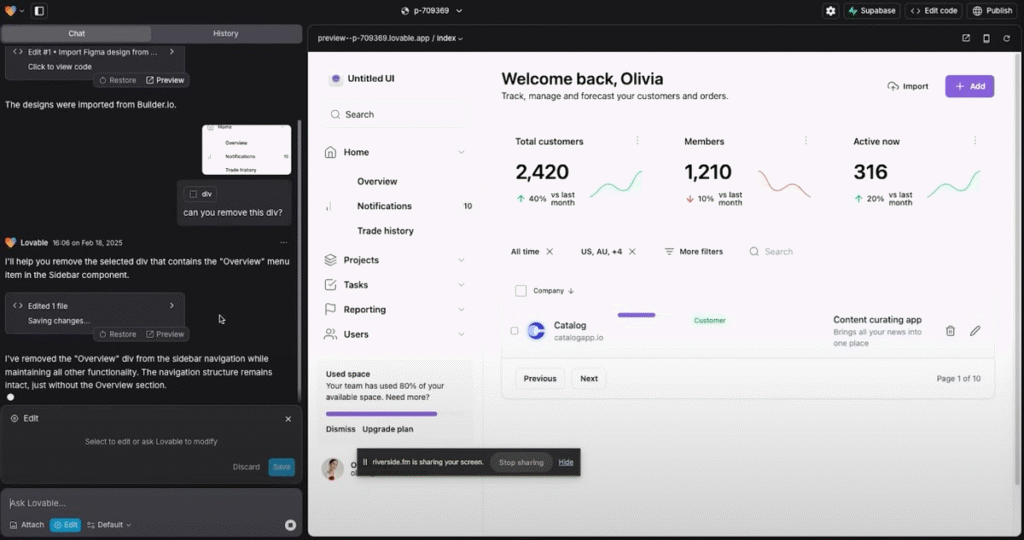
The cost of a “Customized Solution” has dropped to near zero.
This shifts the power dynamic entirely. The “Salesperson” who can only talk about the roadmap is useless. The “Architect” who can deploy a solution in real-time is godlike.
We are moving from a world of “Selling Promises” to a world of “Delivering Prototypes.” And to survive in this world, human charm isn’t enough. You have to be a builder.
The New Species: The AI Business Architect
So what do we call this person? The one who doesn’t just sell, but audit and build?
I call them the AI Business Architect.
This role is a fusion of three traditional jobs that used to be separate silos:
- Salesperson: You still need to understand the client’s business pain. AI can’t read the room (yet).
- Product Manager: You need to translate that pain into a system requirement, not just a feature request.
- Technical Architect: You need to know how to orchestrate Agents, API calls, and workflows to solve the problem.
In the past, you needed three people to do this. The friction between them (“Sales sold vaporware again!”) was the cost of doing business.
Now, that friction is removed. One person, equipped with a fleet of agents, can traverse the entire stack.
This is why the “Social Salesperson”—the one whose primary skill is buying dinner and being charming—is dying. When a client has a technical problem, they don’t want a dinner. They want a solution. They prefer talking to an AI that knows the documentation perfectly over a human who has to “get back to you on that.”
The market is shifting from Relationship-Based Sales to Competence-Based Sales. And the ultimate competence is building the solution right in front of their eyes.
Don’t Wait to Be Disrupted. Do It Yourself.
So, what should you do on Monday morning?
Don’t hoard your anxiety scrolling X . And don’t blindly “learn AI tools” without a purpose.
You need to start disrupting your own job.
Most people are waiting. Waiting for the company to issue an “AI Policy.” Waiting for IT to buy ChatGPT Enterprise. Waiting for permission.
If you are waiting, you are losing.
Buy the AI yourself. Pay the $20/month. Treat it as your personal R&D budget.
Then, look at your workflow and ask: “How would I replace myself today?”

- That weekly report you write? Engineer an agent to write it.
- That client onboarding email sequence? Build a workflow to personalize it automatically.
- That demo data setup? Create a script to generate it in seconds.
This is not about “saving time.” This is about training your architectural capability.
By forcing yourself to automate your own job, you learn the boundaries of the technology. You learn where AI hallucinates, where it shines, and how to structure data so it understands.
You are effectively building the “AI Teammates” that will eventually replace the manual parts of your role. But because you built them, you become their manager. You upgrade yourself from “Worker” to “Architect.”
The person who starts building these personal agents today gains a Compound Knowledge Advantage. In six months, while your colleagues are still asking IT for permission, you will be operating as an Exponential Organization of one.
There is only one seat at the table for the person who controls the agents. Make sure it’s you.