Selling AI solutions to enterprises has turned out to be far more complex than it looks.
The market is full of hype around “agent” breakthroughs — from OpenAI’s browser-capable models to automation stacks like N8N. But most of these products still sit closer to the consumer and SMB side of the spectrum.
Over the past few months, I’ve been chasing the most “AI-friendly” zones — places where AI feels less like a demo and more like real leverage. Manufacturing, e-commerce, law, consulting — I’ve tried them all. It’s been a quick A/B test across industries, ICPs, product angles, and sales motions.
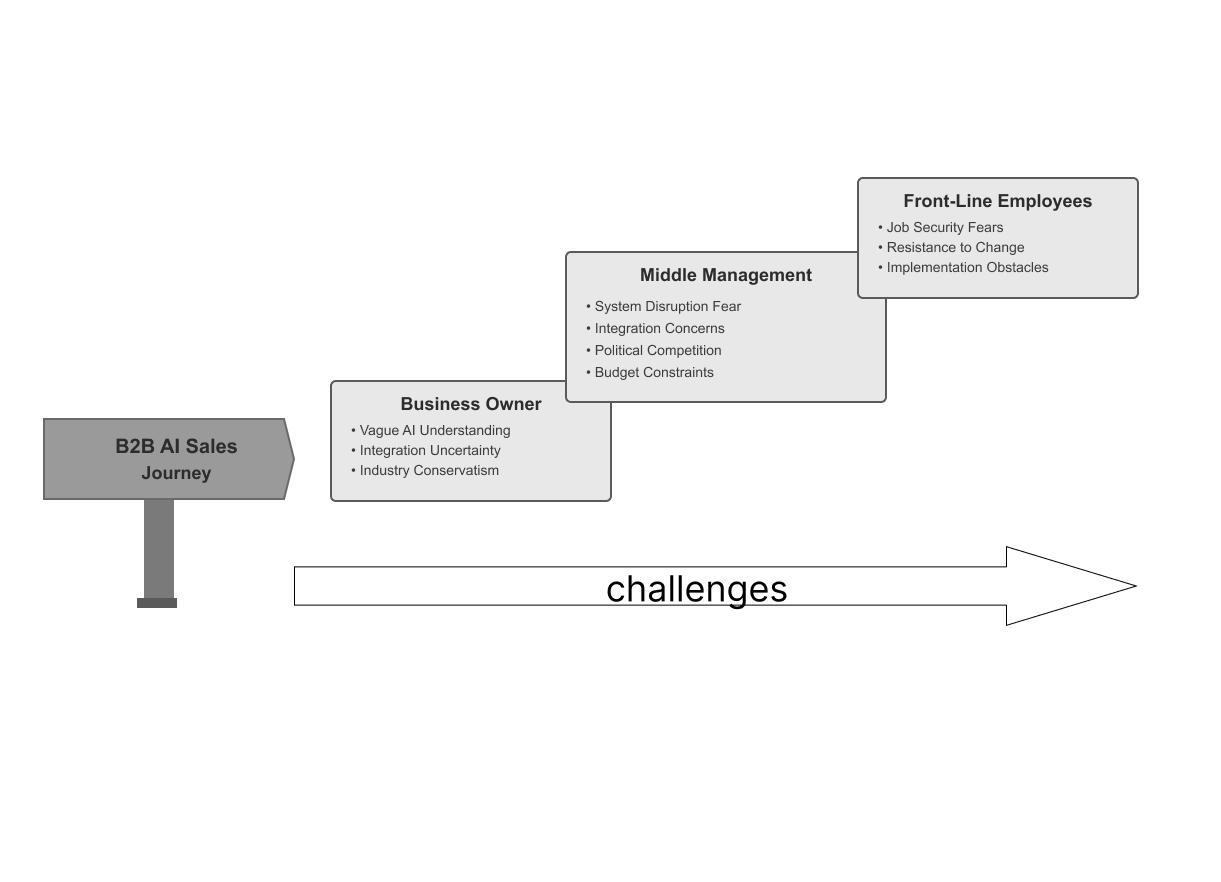
The biggest friction in enterprise AI adoption tends to show up at three critical stages:
1. The Business Owner Level
They normally have some rough idea about what AI can do, but not sure the exact “can-do” of AI/ agent system, and how it can integrate into their business/ existed systems.
Every industry have a general different level of understanding, I’ve found e-commerce is more open, and manufacturing & transporting are the most conservative.
For AI solution providers, the ideal way to engage them is by showing ready-to-use examples — concrete use cases that help customers imagine how AI could fit their world. It’s a classic B2B challenge: as Steve Jobs said, “people don’t know what they want until you show it to them.”
But here’s the paradox for startups — we rarely have dozens of polished use cases. Most of the time, we enter the conversation with one or two demos and use them as a thinking tool to help customers uncover their own needs. That’s how discovery actually happens.
Palantir used this model early on. They had one powerful demo, and used it to map customer pain points across entirely different industries — guiding clients to see how the same technology could solve their specific problems.
The process works best when the decision-maker already has a conceptual understanding of AI. For example, one of my clients — a 20-year-old company — had a CEO who wanted to explore how AI could drive efficiency. He already had a clear mental model of what AI can and can’t do, which made the initial conversation productive.
Still, even with an aligned CEO, the next hurdles usually appear with the department heads or IT teams — the ones who must turn vision into action.
2. Middle-level Managers Level
Department heads fear disrupting existing corporate systems. They often ask the same question: “Can this integrate with our existing SaaS tools or workflows?”
I see this concern on two levels.
First, they don’t want to abandon what they’ve already built. They want improvement, not replacement. If our AI agents completely overtake their existing systems, it could change how the team operates — even how the department is managed. Suddenly, the CEO might question the value of what the manager and their team spent years building. That creates insecurity.
Second, we’re not just competing on product features — we’re entering a political game against existing SaaS vendors, internal budgets, and the finance team’s rules. It’s a system of power — not just tools.
3. The Front Line Level
The final hurdle is the front-line employee. Employees want job security, so they resist change.
I won’t hesitate to say it: AI will change how people work. When you try to integrate AI agents into a company’s daily workflow, you face a wall of friction from the front-line workers.
For example, in one of my cases, the CEO was eager to adopt AI. He wanted it to analyze data and help him make better decisions. But when we tried to work with his IT team to integrate data from their existing systems, the project stalled. The IT team found an endless list of “challenges” and excuses.
The project has been stuck for weeks, and the reason is obvious: the employees know this agent might replace their jobs, or at least threaten the responsibilities they cover.
These are the three main walls I’ve hit selling B2B AI products in 2025. As a startup, we can’t afford to run through walls. We have to find the doors.
Our path forward has to be based on these facts:
- We don’t have the resources to educate the market. We must find customers who already understand AI’s potential.
- We must find the “spot” existing SaaS can’t cover. Or, we must provide a 10x better solution, (which, let’s be honest, is rare and hard to prove).
- Don’t fight over existing value—create new value. Make people feel stronger because of AI, not threatened by it.
So, the smarter path for an AI provider isn’t to threaten the current system, but to expand it. Find the “no man’s land”—the untapped areas where AI can enhance existing workflows. Reframe our value around that.
Managers are far more willing to adopt solutions that empower their teams without blowing up their entire structure.