
A friend pinged me on Signal in early May. L6 at Meta, nine years in, got laid off.
AI is the only thing anyone wants to fund, but he’s 38, has two kids in a Bay Area mortgage.
I told him what I’d tell anyone in that seat in May 2026. The thing he should be aiming at is called a Forward Deployed Engineer (FDE), By the end of that same week, he had three intro calls lined up — one of which was a $4B fund that had been spun out four days earlier.
This essay is for everyone else in that seat.
What just happened in ten days
Between May 4 and May 14, 2026:
- OpenAI spun out the OpenAI Deployment Company with $4B in initial capital from TPG, Advent, McKinsey, and Bain. Same week, they quietly acquired Tomoro and absorbed roughly 150 applied-AI engineers in a single transaction.
- Anthropic announced a $1.5B joint venture with Blackstone and Goldman Sachs, custom-built to embed engineers inside banks. The first deployment, with FIS, compressed AML investigations from “hours to minutes” — the actual phrase in the press release, with no marketing softening.
- Google Cloud CEO Thomas Kurian wrote on LinkedIn that “the pilot era is over” and announced “hundreds” of new Agent Engineer hires.
- ServiceNow and Accenture co-launched a parallel embedded-engineer program. IBM Consulting rolled out something they’re calling Forward Deployed Units — six-person hybrid squads pairing humans with agent “digital employees”, ostensibly delivering the output of a traditional 30-person team.
Five organizations, three product categories, one bet. $5.5B committed capital pointed at the same job description across those ten days:
The job is Forward Deployed Engineer (FDE).
By any honest reading, this is the hottest single-role market in tech right now.
You haven’t heard about it because it doesn’t look like AI from the outside. It looks like consulting.
What FDE actually is
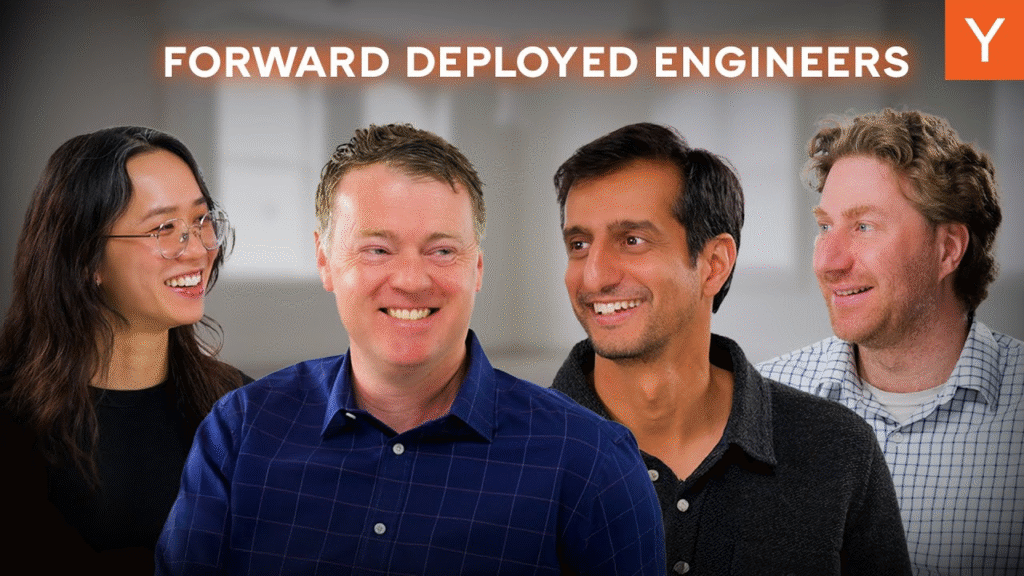
The simplest version: an FDE is an engineer the lab embeds inside a customer’s office, sometimes for 18 months at a time, to ship working AI agents against the customer’s real data, real workflows, and real compliance perimeter.
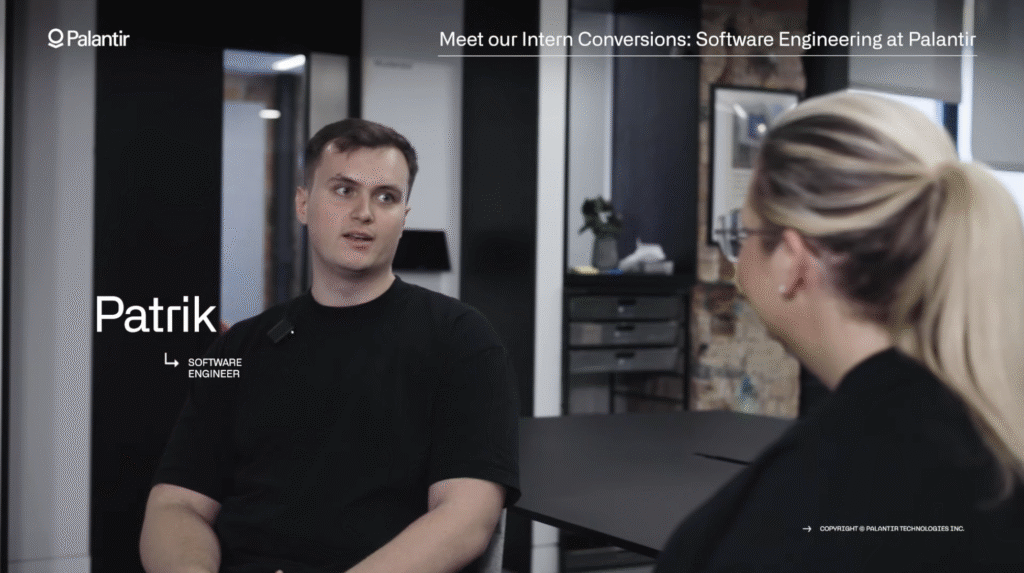
Palantir invented the role around 2003 to serve agencies that couldn’t write a coherent requirements doc. Their co-founder Shyam Sankar has a line about this that the whole industry is now quoting: “If a problem could be solved with a requirements document, it would have been solved already.”
That is the FDE thesis in one sentence. And it is why every frontier lab is now copying the Palantir playbook with their checkbook.
The work itself is unglamorous. Mostly you are mapping fields between an Oracle database that hasn’t been touched since 2014 and a Claude API that’s three weeks old; writing eval harnesses; sitting in a windowless room with the customer’s CISO trying to explain why a probabilistic model can’t be wrapped in a try/except.
Of the work an FDE does in their first year at a customer — maybe 15% of it is anything you’d recognize as “AI engineering.” The rest is the connective tissue. The plumbing. The diplomacy. The dirty work.
The labs are paying a quarter-million dollar premium over a comparable L6 platform job because almost nobody on their existing payroll has the temperament to do it.
Why this market exists at all
MIT NANDA’s 2024 study — 95% of enterprise GenAI pilots produced no measurable business value.
That’s the punchline. The frontier model layer is extraordinary. The integration layer between the model and a real business is broken in ways the labs can’t fix from headquarters.
Sanchit Gogia at Greyhound Research has the cleanest framing I’ve read: “The Forward Deployed Engineer is the invoice for making AI real.” For a year that deploying an agent looks more like hiring an employee than installing software.
That is a structural observation about why AI delivery is currently labor-bound.
So we have a clean setup: a $500B+ enterprise opportunity gated by a workforce that doesn’t exist yet, and frontier labs willing to pay almost any number to lock up the few people who can do the work. This is what a real talent arbitrage looks like.
BUT, here is an interesting twist: this arbitrage closes.
Gartner analyst Alex Coqueiro has put a timer on it. By 2028, his estimate is that 70% of FDE-led enterprise agent projects will be abandoned
What this means in practice: there is a 24-to-36 month window in which the FDE role is being mispriced by the labs as a frontier engineering hire because they desperately need bodies.
After that, the role compresses into something that looks much more like high-end offshore systems integration at a quarter of today’s comp band.
Get in while the curve is inflecting, or accept that the seat will close.
Three doors
Door 1: The big-tech engineer who just got cut
This is the door I told my friend to walk through.
You spent the last 8-12 years at big tech, or one of the second-tier survivors. You owned infrastructure that fifteen thousand engineers depended on, or you ran a service that touched three billion users.
Here is the inventory you don’t realize you have:
- Production discipline. You know what 99.95% actually means when a paying customer is reading the SLA. Most lab-trained AI engineers do not have this in their bones.
- Cross-system debugging. The FDE job is essentially following a request across seven services owned by four teams to find where the agent’s tool call is silently failing. You’ve done this for a decade.
- Spec writing, code review, on-call. The labs need adults who can run a delivery team inside a customer’s security perimeter. There are not enough of them anywhere.
- AI tooling fluency. You already write code with an LLM in the loop. You understand context windows. You’ve debugged a prompt that worked yesterday and broke today.
Here is what you’re missing:
- Vertical context. You built generic platform tools or consumer products. You’ve never had to explain to a compliance officer at a regional bank why an agent’s tool call retried three times and triggered a duplicate wire transfer.
- Customer skin. Most big-tech ICs above L5 have never sat in a room with an external customer for eight straight hours. The first time a CIO asks you a question you can’t answer in front of their CTO is going to feel awful.
- Production AI engineering. Using Claude Code to ship an agent that runs autonomously inside a regulated workflow lives somewhere else entirely — eval harnesses, guardrails, drift detection, human-in-the-loop checkpoints. The gap between “I use AI to write code” and “I build AI systems for someone else to run without me” is 6-8 months of focused work.
Entry price: a year of trading platform prestige for industry immersion. When Anthropic’s Applied AI team built the financial-crimes agent inside FIS, the bulk of the work was a streaming pipeline that silently dropped messages between core banking and the agent’s tool layer for two months before anyone caught it.
Trap: applying with the same resume frame that got you into Meta. Recruiters at OpenAI DeployCo and Anthropic Applied AI have screened thousands of ex-FAANG L6s in the last six months.
The ones who get through lead with a deployment. Even a six-week internal pilot showing you shipped an agent end-to-end at your last employer beats three years of perf reviews.
Door 2: The vertical expert with no code
You’re a credit risk officer at a regional bank, a clinical informaticist at a hospital system, an operations planner at an industrial supplier, a treasury operations lead at a midmarket asset manager.
You know exactly which 30 workflows in your industry are about to be eaten by agents — you live inside them.
Your entry price is the steepest of the three. You need to become technical enough that an FDE team trusts you on a production codebase.
Your moat is also the steepest. When OpenAI’s FDEs went into John Deere and got herbicide use down 70% on the precision recommendation agent, the limiting factor was knowing what a row-crop agronomist actually does in the cab in late June. You arrive on day one as that person. The engineers cannot.
Trap: Hiring managers want code in your hands and a real deployment on your resume — even a six-week internal pilot at your current employer.
Build one before you apply. Sankar at Palantir likes calling FDEs “heretics inside their own industries” — the ones who already see what’s broken and refuse to wait for permission to fix it. That’s the energy the role selects for.
Door 3: The new grad with no industry, no AI, no idea
You’re 22. CS degree, or econ, or chemistry. Your peers are split between people chasing Meta offers and people stalling in a master’s program because they can’t decide what’s next.
You think you have to choose between pure AI and pure industry. Walk through the third door instead.
FDE is the only career in tech where being undifferentiated at 22 is an actual advantage. You have no industry baggage to unlearn, no codebase loyalty, no opinion about how things “should” work.
Nexus dropped a team of exactly this profile into Orange Group across multiple European markets earlier this year — your only job for the first year is to learn faster than anyone else in the room.
Entry price: your early twenties belong to airports, customer conference rooms, and onboarding sessions for legacy enterprise software you’ll never use again.
You’ll be at a 200,000-employee insurance company learning how their broker hierarchy works while your friends are at a startup with a foosball table.
Trap: optimizing for prestige in year one. What compounds is the agent you shipped end-to-end inside Heineken or Nestlé. That stays on your résumé through three funding cycles.
The thing nobody puts in the job ad
I want to be honest about the parts the recruiters skip.
The first year is mostly not what you’d call AI work. You are cleaning other people’s data. You are negotiating with a CISO who doesn’t trust your model. Some FDEs burn out at the 18-month mark for exactly this reason.
The labs already know this. IBM’s Forward Deployed Units are an early attempt to engineer around it — Mohamad Ali, who runs IBM Consulting, has been explicit that the FDU structure is meant to dilute single-engineer dependency by routing repetitive scaffolding to agents while humans take the judgment calls.
Constellation Research’s critique is also worth sitting with. If frontier AI companies are accidentally becoming consulting firms, then the people doing the consulting are accumulating exactly the institutional knowledge that makes the labs work. Which means your three years of dirty work at DeployCo are also training you to be the next generation of lab leadership.
That is the compound.
Why now
The cleanest historical analog for this moment isn’t the LLM boom of 2023. It’s the cloud transition of 2008-2015.
The people who got rich on the cloud transition were the ones standing in two worlds — AWS-native and SAP-native at the same time. Integration was the value. Cloud was the commodity.
The window opened in May 2026. By my read, it stays open through roughly mid-2028 — long enough to do one or two real deployments and accumulate the moat.
After that, MCP-style standardization, agent-native delivery tooling, and offshore systems integrators compress the role into something much closer to managed-services pricing, and the comp band collapses.
You have about 30 months. Use them.
Pick a door. Pay the price. The compound is real.
References
Links current as of May 24, 2026. Where the canonical announcement is a press release, the corporate newsroom URL is given; where the canonical source is a research note behind a paywall, the publishing analyst firm’s domain is given so the reader can locate the underlying report.
[1] OpenAI. “Introducing the OpenAI Deployment Company.” OpenAI Blog, May 5, 2026. https://openai.com/index/openai-deployment-company/
[2] OpenAI. “OpenAI acquires Tomoro.” OpenAI Blog, May 2026. https://openai.com/index/openai-acquires-tomoro/ — see also Tomoro company background: https://tomoro.ai
[3] Anthropic. “Anthropic, Blackstone, and Goldman Sachs launch joint venture to deploy AI in financial services.” Anthropic News, May 7, 2026. https://www.anthropic.com/news
[4] FIS Global. “FIS and Anthropic deploy AI agent for financial crime investigation.” FIS Newsroom, May 2026. https://www.fisglobal.com/en/about-us/media-room
[5] Kurian, Thomas. “The pilot era is over.” LinkedIn post, May 11, 2026. https://www.linkedin.com/in/thomaskurian28/
[6] ServiceNow. “ServiceNow and Accenture launch joint AI deployment practice.” ServiceNow Newsroom, May 12, 2026. https://www.servicenow.com/company/media/press-room.html
[7] IBM. “IBM Consulting introduces Forward Deployed Units.” IBM Newsroom, May 14, 2026. https://newsroom.ibm.com — Mohamad Ali interview context: https://www.ibm.com/consulting
[8] LinkedIn Economic Graph. “Emerging Jobs Report, Q4 2025.” https://economicgraph.linkedin.com/research
[9] Sankar, Shyam. Palantir Investor Day remarks and recurring interview quote on FDE methodology. Palantir public commentary: https://www.palantir.com/newsroom/ — see also Sankar’s Acquired Podcast episode (2024): https://www.acquired.fm
[10] MIT NANDA / MIT Media Lab. “The GenAI Divide: State of AI in Business 2024.” 2024. https://nanda.media.mit.edu/ — coverage of the 95% finding: https://fortune.com/2024/08/ (search “MIT NANDA 95%”)
[11] Gogia, Sanchit. “The Forward Deployed Engineer is the invoice for making AI real.” Greyhound Research analyst note, Q1 2026. https://greyhoundresearch.com/
[12] Levie, Aaron. X (Twitter) thread on AI deployment as hiring, late 2024–2025. https://x.com/levie
[13] Coqueiro, Alex (Gartner). “Predicts 2026: 70% of enterprise agent projects will be abandoned by 2028.” Gartner research note, Q1 2026. https://www.gartner.com/en/newsroom
[14] Constellation Research. Analyst commentary on frontier AI labs operating as consulting businesses with software valuations. https://www.constellationr.com/blog-news
[15] Meta Platforms. “Year of Efficiency” and subsequent 2025-2026 perf cycle communications, summarized across Q4 2025 earnings call transcript and subsequent reporting. https://investor.atmeta.com
[16] John Deere & OpenAI. See & Spray precision-agriculture deployment case study, 2025. https://www.deere.com/en/news/ — herbicide-reduction figures: https://www.deere.com/en/sprayers/see-spray/
[17] Nexus / Orange Group. Customer-service agent deployment case study, Q1 2026. https://www.orange.com/en/newsroom and https://nexus.ai (case study)
[18] Anthropic. “Introducing the Model Context Protocol.” November 2024 (initial), ongoing standard. https://www.anthropic.com/news/model-context-protocol — spec: https://modelcontextprotocol.io